Best Ski Jackets for Touring: The Definitive Editorial Guide
The distinction between a standard resort parka and a technical alpine shell becomes visceral precisely at the moment the chairlift disappears. In the backcountry, a jacket is no longer a passive barrier against the cold; it is a critical component of a thermodynamic exchange. The “touring” environment—characterized by high-metabolic uphill exertion followed by static transitions and high-speed, wind-chilled descents—demands a level of moisture management that static resort gear cannot provide. The primary challenge is not keeping the elements out, but rather facilitating the escape of internally generated heat and vapor before it condenses into a chilling layer of sweat.
For the serious practitioner, the procurement of an outer layer is an exercise in balancing weight, durability, and breathability. This is a landscape governed by the “Goldilocks” principle: a jacket that is too protective (heavy hardshell) will lead to overheating on the skin track, while one that is too permeable (ultralight softshell) risks exposing the user to convective heat loss during a ridge-top storm. The engineering required to bridge these two extremes involves sophisticated membrane technology, strategic venting, and ergonomic tailoring that accounts for the constant motion of climbing.
The evolution of alpine apparel has moved away from the “one-jacket” myth. To analyze the marketplace is to recognize that the “ideal” shell is a moving target, shifting with the humidity of the region, the steepness of the ascent, and the objective’s duration. This editorial serves as a definitive deconstruction of the mechanical and material variables that define the premier tier of alpine shells, providing a roadmap for those who view the mountains not as a destination, but as a system of challenges.
Understanding “best ski jackets for touring”
Identifying the best ski jackets for touring requires a departure from the “waterproof” obsession that dominates general outdoor marketing. In a touring context, “waterproofness” is often the enemy of “dryness.” If a membrane is so dense that it prevents the egress of sweat during a 1,500-vertical-foot climb, the user will be wet from the inside out—a condition far more dangerous in freezing temperatures than a few drops of external sleet.
Common misunderstandings center on the “hardshell vs. softshell” binary. Many assume a hardshell is a requirement for all winter mountain travel. In reality, in arid climates like the Rockies or the High Sierra, a high-quality softshell is frequently the superior touring choice due to its CFM (Cubic Feet per Minute) air permeability. The oversimplification risk lies in treating a jacket as a static object. High-end touring apparel is dynamic; it utilizes “Active Exchange” technology—membranes that don’t just wait for a pressure differential to push air out but actively respond to the user’s movement.
A multi-perspective analysis involves:
-
The Ergonomic Perspective: How the “cut” of the jacket interacts with a backpack harness and the high-reaching motions of kick-turns.
-
The Logistical Perspective: Packability; how much volume does the shell consume in a 32-liter bag during the heat of the day?
-
The Safety Perspective: Compatibility with climbing helmets and the accessibility of chest pockets while wearing a beacon or harness.
Historical and Systemic Evolution of Alpine Shells
The lineage of the touring jacket began with heavy waxed cotton and wool, materials that relied on density and natural oils to repel moisture. While durable, these were catastrophic in high-output scenarios, becoming waterlogged and dangerously heavy. The “Gore-Tex Revolution” of the 1970s introduced the expanded Polytetrafluoroethylene (ePTFE) membrane, which theoretically allowed vapor to escape while blocking liquid water. This systemic shift moved the industry toward the “Hard Shell” era, which dominated the 1980s and 90s.

However, the “hardshell” was designed for the “downhill” user. The 2010s saw a systemic push toward “Hybridization” and “Air Permeability.” Brands began to realize that for the skin track, a membrane that allowed some wind to pass through was actually an asset for cooling. This led to the development of electrospun membranes (like Futurelight) and the refinement of high-density weaves (like Pertex Equilibrium) that offer weather resistance without a plastic-like barrier. Today, the market is defined by “Material Specificity,” where a jacket is designed for a specific sub-niche of touring, from fast-and-light skimo racing to deep-winter volcano circumnavigations.
Conceptual Frameworks and Thermodynamic Mental Models
Navigating the procurement process is best handled through mental models that prioritize the “User-in-Environment” system.
1. The “Micro-Climate Management” Model
This model treats the jacket as a thermostat, not a blanket. The goal is to maintain a constant “Micro-Climate” near the skin. In this framework, the jacket’s success is measured by how little the user has to adjust their layers throughout the day. A jacket that stays on from trailhead to summit is the “Holy Grail” of touring design.
2. The “Vapor Pressure Gradient” Framework
Physics dictates that moisture moves from areas of high pressure (inside your jacket) to low pressure (the outside air). This framework suggests that a shell is only as good as the temperature differential. In very humid, warm-weather touring (e.g., a PNW rain-crust day), even the “best” shell will fail because the pressure gradient is too shallow to push vapor out.
3. The “Weight-to-Protection” Ratio
This is a logistical mental model. Every gram of “protection” (thick face fabrics, extra zippers, powder skirts) is a gram that must be carried uphill. The model encourages the user to evaluate the “Necessity of Feature” against the “Metabolic Cost” of carrying it. For most touring, the “Minimalist” shell wins.
Key Categories of Touring Jackets
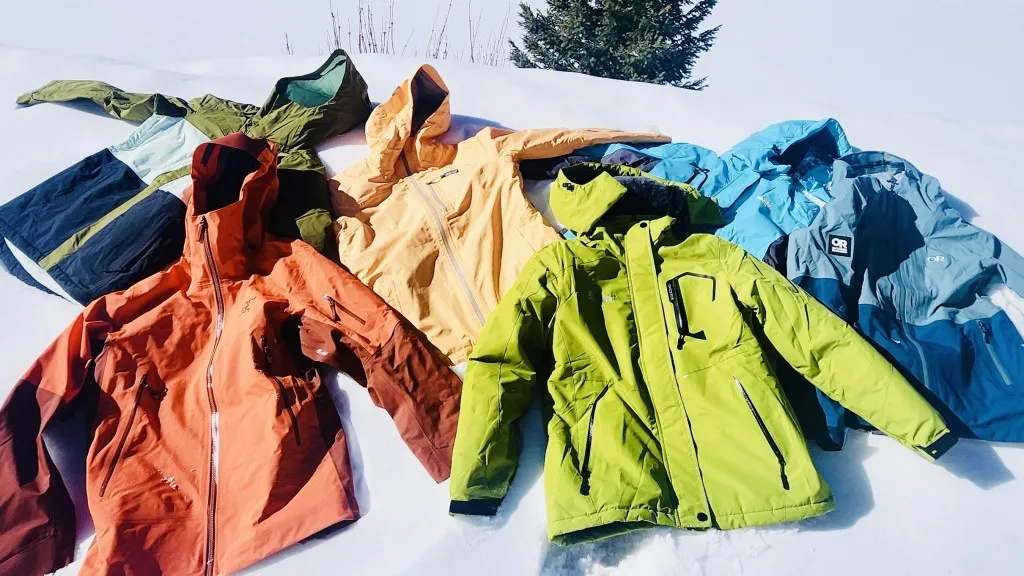
| Category | Primary Benefit | Significant Trade-off | Ideal Use Case |
| Ultralight Hardshell | 100% waterproof; weighs <300g. | Low durability; minimal features. | Fast & Light summer peaks. |
| Air-Permeable Shell | Constant airflow; very high breathability. | Not fully waterproof in a downpour. | High-output climbing in cold air. |
| Hybrid (Mapped) Shell | Hardshell on shoulders; softshell on torso. | Complex fit; can have cold spots. | High-alpine touring with heavy packs. |
| Technical Softshell | Maximum comfort; durable; quiet fabric. | Will eventually soak through in rain. | High-desert/Arid mountain ranges. |
| Gore-Tex Pro (Rugged) | Bombproof protection; long life. | Heavy; loud (crinkly); low CFM. | Deep winter; storm-chasing. |
Detailed Real-World Scenarios
Scenario A: The “Maritime” Wet-Out
-
Context: Touring in the Cascades (Washington) in 34°F “Pineapple Express” sleet.
-
The Failure: Using a softshell or a lightweight “Active” shell. The fabric’s DWR (Durable Water Repellent) is overwhelmed by the sheer volume of water.
-
The Logic: In this specific scenario, a 3-layer Gore-Tex Pro hardshell is the only viable tool. While the user will sweat, they will be protected from the more dangerous “conductive” cooling of rain.
Scenario B: The “Continental” Skin Track
-
Context: A -10°F morning in the Teton Range, Wyoming.
-
The Constraint: The air is extremely dry. A hardshell would trap too much frost on the inside of the membrane.
-
The Strategy: A high-CFM softshell paired with a “Puffy” over-layer for transitions. The softshell allows the sweat to pass through as a gas before it can freeze against the shell’s interior.
Planning, Cost, and Resource Dynamics
The “Cost per Wear” of a high-end touring shell is significantly lower than a resort jacket because it is used across more seasons (mountaineering, hiking, skiing).
| Component | Price Range | Lifecycle | Notes |
| Premium Touring Shell | $450 – $850 | 5-8 Years | Focus on 3-layer construction. |
| DWR Re-treatment | $15 – $25 | 6 Months | Essential for maintaining breathability. |
| Technical Wash | $10 – $20 | 10 Wash Cycles | Prevents skin oils from clogging pores. |
| Professional Repair | $40 – $80 | As needed | Taping seams after a branch tear. |
Opportunity Cost: Choosing a cheap, 2-layer “lifestyle” shell for touring often results in the “Plastic Bag” effect. The $300 saved is lost in the form of decreased performance, increased risk of hypothermia from sweat-saturation, and the eventual need to replace the jacket after one season of technical abuse.
Tools, Strategies, and Support Systems
The best ski jackets for touring are force multipliers when combined with the correct “Systems Approach.”
-
Hem-Lock Adjusters: Essential for keeping the jacket from riding up while wearing a climbing harness.
-
Pit Zips vs. Core Vents: Pit zips allow for massive air dump; core vents (mesh pockets) provide a more subtle exchange.
-
Articulated Elbows: Ensures that when you reach for an ice tool or pole plant, the sleeves don’t pull back from your gloves.
-
High-Collar Design: A collar that stands independently of the hood, allowing for face protection without obstructing vision.
-
Skin Pockets: Oversized internal mesh pockets designed to keep climbing skins warm with body heat (preventing glue failure).
-
RECCO Reflectors: A passive search tool that is now standard in high-end touring shells for added safety.
Risk Landscape and Failure Modes
Backcountry apparel systems are subject to “Compounding Risk.”
-
DWR Failure (The Wet-Out): When the outer fabric becomes saturated, vapor cannot escape. The jacket becomes a non-breathable plastic sheet.
-
“Shimmying” (Internal Condensation): In extreme cold, vapor can turn to ice inside the jacket’s pores, blocking all air exchange.
-
Mechanical Abrasion: Touring involves “bushwhacking” and rock scrambling. A lightweight shell that tears easily in the sub-alpine becomes a liability when the wind picks up at the summit.
-
The “Tucking” Error: Tucking a jacket into pants traps all rising heat and moisture, leading to a “Sauna” effect that eventually results in deep-chilled base layers.
Governance, Maintenance, and Long-Term Adaptation
A touring shell is a technical instrument that requires a “Review and Refurbish” cycle.
-
Cleaning Frequency: Contrary to popular belief, washing a technical shell improves its performance. Skin oils and salt from sweat are hydrophilic—they attract water and destroy DWR.
-
DWR Refresh: If water is no longer “beading” on the surface, the jacket’s breathability has dropped by up to 70%.
-
Adjustment Triggers: If a user finds themselves constantly “fiddling” with zippers on the uphill, it is a signal that their shell is either too heavy or their base layers are too thick.
Measurement, Tracking, and Evaluation
-
The “Drying Time” Metric (Qualitative): How long does it take for the jacket to feel “dry” to the touch after a 1,000-foot climb?
-
Vapor Escape (Visual): On a cold day, do you see “steam” rising from the fabric surface? This is a sign of a high-functioning membrane.
-
The “Range of Motion” Test: Can the user perform a 180-degree arm sweep without the hem of the jacket lifting above the waistline?
Common Misconceptions and Industry Myths
-
Myth: “Gore-Tex is always the best.”
-
Correction: Gore-Tex is a brand, not a single material. Some Gore-Tex versions (like Paclite) are poorly suited for high-output touring compared to “off-brand” electrospun membranes.
-
-
Myth: “Pockets are just for storage.”
-
Correction: In touring, pockets are “Active Vents.” Opening mesh-lined chest pockets is often more effective than pit zips for cooling the core.
-
-
Myth: “A heavier jacket is warmer.”
-
Correction: In touring, warmth comes from your mid-layers. The shell is merely a “wind-stopper.” A heavy shell often makes you colder by making you sweat more.
-
-
Myth: “Hoods are only for when it’s snowing.”
-
Correction: A hood is a vital tool for regulating temperature. 30% of heat loss occurs at the head; putting a hood on during a transition can prevent a core-temperature drop.
-
Conclusion: The Professional Synthesis
The selection of the best ski jackets for touring is an acknowledgment that the backcountry is an arena of constant flux. There is no static “perfection,” only a set of adaptations. The modern alpine shell has evolved from a simple protective layer into a sophisticated membrane that serves as the interface between human physiology and the atmospheric extremes of the mountain.
Success in the backcountry is found in the “Thermal Middle Ground.” By prioritizing air permeability, ergonomic tailoring, and rigorous maintenance of DWR coatings, the trekker ensures that their gear remains a silent partner in the ascent. The ultimate shell is one that the user forgets they are wearing—a transparent participant in the balance between the heat of the climb and the cold of the peak.