Compare Ski Wax Options: The Definitive Editorial Guide to Glide
The interface between a ski’s base and the snow surface is a theater of high-velocity thermodynamics. To the casual observer, wax is merely a substance applied to make a ski “fast.” However, in the realm of advanced alpine performance, wax functions as a sacrificial lubricant and a chemical barrier designed to manage the specific crystalline geometry and moisture content of the snowpack. The physics of glide are governed by the creation of a microscopic meltwater film; if this film is too thin, dry friction impedes movement, and if it is too thick, capillary suction creates a braking effect.
Modern glide technology has entered a period of significant transition. For decades, the industry relied on perfluorinated chemicals to achieve extreme water hydrophobicity. With the global regulatory shift toward PFAS-free alternatives, the science of wax has shifted toward complex hydrocarbon blends, ceramic additives, and biodegradable esters. This evolution has made the decision-making process for the end-user significantly more complex. It is no longer a matter of matching a color to a temperature, but of understanding how different chemical compositions interact with humidity, snow age, and base porosity.
Systemic mastery of this domain requires an analytical approach to the various formulations available. A skier must balance the technical ceiling of a wax against its ease of application and its environmental footprint. This editorial deconstructs the chemistry and utility of contemporary glide media to provide a definitive reference for those seeking to optimize their equipment’s interaction with the mountain.
Understanding “compare ski wax options.”
To accurately compare ski wax options, one must first dismantle the oversimplification that “speed” is the only metric of success. While glide velocity is the primary objective in a competitive context, for the vast majority of alpine users, the “success” of a wax is measured by its durability, its ability to protect the polyethylene (P-Tex) base from oxidation, and its performance across a broad “thermal window.”
The multi-perspective view of wax selection includes:
-
The Tribological Perspective: How the wax reduces friction against specific snow crystal shapes (e.g., the sharp needles of new cold snow versus the rounded grains of transformed spring corn).
-
The Mechanical Perspective: How the wax fills the amorphous regions of the P-Tex base, providing a reservoir of lubricant that is released as the ski heats up during a descent.
-
The Environmental Perspective: Assessing the shift from fluorinated “forever chemicals” to sustainable plant-based waxes and their relative performance trade-offs.
A significant risk in this domain is “over-specialization.” Using a highly specialized cold-weather wax in rising temperatures can lead to “suction” as the snow melts faster than the wax can repel the water. Conversely, using a soft, warm-weather wax in sub-zero temperatures allows sharp ice crystals to penetrate the wax layer, dragging the ski to a halt and potentially “burning” the base material.
Historical and Systemic Evolution of Glide Chemistry
The trajectory of ski wax began with organic tallows and pine tars, which were primarily used to keep wooden skis from becoming waterlogged. The introduction of P-Tex bases in the mid-20th century revolutionized the sport, as the material was naturally hydrophobic and porous enough to hold paraffin. The 1980s saw the introduction of fluorocarbons (hydrophobic molecules where hydrogen atoms are replaced by fluorine), which offered a leap in performance by virtually eliminating suction in wet conditions.
The current era is defined by “The Great Reset.” International bans on C6 and C8 fluorinated waxes have forced manufacturers to return to hydrocarbon foundations, now reinforced with micronized solids like graphite, molybdenum, and various “eco-fluors.” This shift has democratized glide to some extent; while the absolute speed ceiling may be lower than in the fluorinated era, the consistency and safety of modern paraffin and ceramic blends have made high-level performance more accessible to the recreational masses.
Conceptual Frameworks and Hydrophobic Mental Models
Navigating the market requires mental models that move beyond brand names and focus on the physics of the base-to-snow interface.
1. The “Water Film” Equilibrium
This model assumes that there is an “optimal” thickness of meltwater beneath the ski. If the snow is cold and dry, you need a hard wax that minimizes dry friction. If the snow is wet, you need a high-hydrophobicity wax that breaks the surface tension of the water. The goal is to stay in the “Goldilocks” zone where the water film acts as a ball bearing.
2. The “Base-Saturation” Reservoir
Think of the ski base as a sponge. A single layer of wax is a “surface treatment.” True performance comes from “loading” the base through multiple hot-wax cycles or infrared treatments, creating a reservoir of wax that migrates to the surface as friction generates heat.
3. The “Crystal Aggression” Framework
New snow has sharp, branched crystals (dendrites) that act like saws. Old snow has rounded, icy grains. This framework dictates that hard waxes are for “aggressive” snow to prevent the crystals from digging in, while softer waxes are for “transformed” snow where water repulsion is the primary concern.
Key Categories of Wax Formulations and Trade-offs
When you compare ski wax options, the primary distinctions are found in the delivery method and the chemical “hardness.”
| Category | Primary Benefit | Significant Trade-off | Best Use Case |
| Hydrocarbon (CH) Paraffins | Inexpensive; biodegradable; protects bases. | Narrower temperature windows; shorter lifespan. | Daily maintenance; base conditioning. |
| Non-Fluoro (NF) Performance | High speed; legal for racing; safe for users. | More expensive than basic CH; requires precise application. | Amateur racing; high-performance carving. |
| Liquid/Spray-on Waxes | Zero-friction application; no iron required. | Does not penetrate deep into the base; it wears off quickly. | Travel; mid-day “touch-ups.” |
| Graphite/Molybdenum | Anti-static; repels dirt in old, “black” snow. | Can be messy; only effective in specific snow types. | Spring skiing; high-pollution areas. |
| Ceramic/Solid Additives | Extreme durability; resists abrasion from ice. | Hardest to apply (requires high iron heat); expensive. | Long-distance touring; abrasive man-made snow. |
Detailed Real-World Scenarios
Scenario A: The “Morning Freeze/Afternoon Thaw”
-
Context: A skier starting at 8:00 AM at 15°F, with temperatures expected to hit 45°F by noon.
-
The Strategy: Using a “Wide-Range” hydrocarbon or a dual-layer approach—a harder base layer for the morning crust, topped with a medium-density liquid wax for the afternoon slush.
-
Failure Mode: Using a “Cold” wax all day, which will become “suction-heavy” as the sun hits the slopes.
Scenario B: The “Man-Made” Abrasion
-
Context: Skiing on 100% artificial snow that has been groomed into “ice marbles.”
-
The Mechanism: Artificial snow is denser and more abrasive than natural flakes. It physically “strips” wax off the base.
-
The Solution: A high-durability NF wax with ceramic additives or a “cold” rated paraffin, even if the air temperature is moderate, to resist the mechanical shearing of the ice.
Planning, Cost, and Resource Dynamics
Maintaining a wax program is an exercise in “Sustainment Logistics.”
| Resource Item | Price Range | Frequency | Value Metric |
| Bulk Hydrocarbon Block | $20 – $40 | 15-20 Applications | Base health and protection. |
| NF Racing Wax (Small Block) | $30 – $70 | 3-5 Applications | Maximum speed ceiling. |
| Liquid Glide Spray | $25 – $50 | 10 Applications | Convenience and time-saving. |
| Base Cleaner (Citrus) | $15 – $25 | As needed | Essential for “re-setting” the base. |
Opportunity Cost: The hidden cost of “skipping a wax” is the permanent degradation of the P-Tex. An unwaxed base develops “puzzling” micro-cracks and oxidation that eventually require a stone grind ($80-$100) to fix. Frequent waxing with cheap paraffin is significantly more cost-effective than infrequent waxing with expensive formulations.
Tools, Strategies, and Support Systems
The application is as critical as the formulation. To truly compare ski wax options, one must consider the “Toolchain.”
-
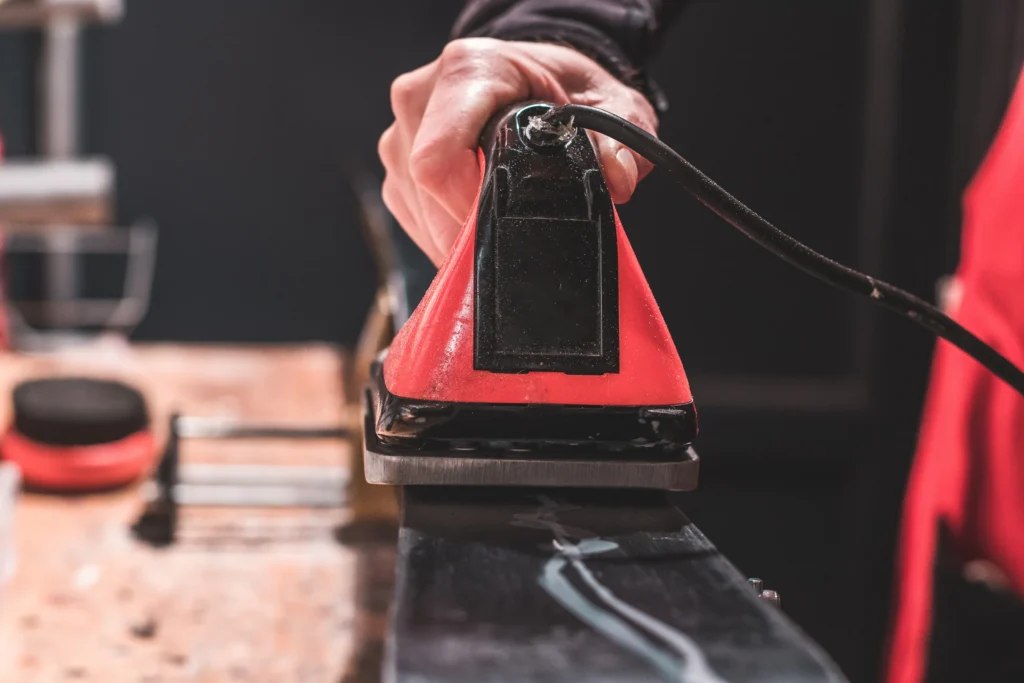
Digital Waxing Iron: Essential for NF waxes, which have high melting points. Standard irons fluctuate too much, risking “burning” the base.
-
Infrared (IR) Waxers: Non-contact heating that allows wax to penetrate without the mechanical stress of an iron.
-
The “Crayon” Method: Rubbing the wax block on the base before ironing to reduce waste and smoke.
-
Plastic Scrapers (Sharpened): A dull scraper leaves wax residue that actually slows the ski down; the “Scrape-and-Brush” phase is where the speed is created.
-
Horsehair vs. Nylon Brushes: Nylon for removing bulk wax; horsehair for “polishing” the structure of the base.
-
Temperature Sensors: Measuring the snow temperature, not the air temperature, as the snow often lags behind air changes by several hours.
Risk Landscape and Failure Modes
-
Thermal Delamination: Applying an iron that is too hot (often above 150°C) to a modern composite ski can cause the internal epoxy to fail, resulting in a “dead” ski with no pop.
-
The “Dirty Base” Trap: Applying new wax over old, dirty wax seals in contaminants. This creates a “sandpaper” effect that increases friction.
-
Over-Scraping: Using too much pressure on a scraper can “de-camber” a ski or gouge the P-Tex.
-
Chemical Incompatibility: Mixing certain fluorinated residues with new NF waxes can result in a “cloudy” base that repels the new wax.
Governance, Maintenance, and Long-Term Adaptation
A successful wax program requires a “Monitoring and Review” cycle based on visual and tactile signals.
-
Monitoring Trigger: Look for “whiteness” near the edges (the high-friction zone). This is the first sign of oxidation.
-
Review Cycle: Every 3–5 days of skiing, a “Reset” should occur—cleaning the base and reapplying a fresh saturation layer.
-
Adaptation: As a ski ages, its base becomes more “closed” and less porous. Older skis benefit from more frequent liquid wax applications to supplement the diminishing internal reservoir.
Layered Maintenance Checklist:
-
Base Clean: Is the P-Tex free of gray/black “dirt” streaks?
-
Iron Temp: Is the iron set to the specific temperature listed on the wax packaging?
-
Scraping: Has all visible surface wax been removed (leaving only what is in the pores)?
-
Brushing: Is the base “structure” visible and clear of debris?
Measurement, Tracking, and Evaluation
-
The “Water Drop” Test (Quantitative): Place a drop of water on the waxed base. If it beads into a tight sphere, hydrophobicity is high. If it flattens, the wax is gon,e or the wrong type was used.
-
The “Friction Feel” (Qualitative): On a flat “cat-track,” does the ski maintain momentum, or do you feel a “tugging” sensation?
-
Base “Patina” Documentation: Tracking how long it takes for a specific wax formulation to show “edge burn” in local conditions.
Common Misconceptions and Industry Myths
-
Myth: “Liquid wax is a scam; it doesn’t work.”
-
Correction: Modern NF liquids are chemically advanced; they don’t replace hot waxing for base health, but they are often faster on the surface for a few runs.
-
-
Myth: “Fluoro waxes are still ‘safe’ if I have old stock.”
-
Correction: Beyond the environmental impact, fluoros are now banned in almost all competitive circuits and can result in significant fines and disqualification.
-
-
Myth: “Hot-waxing more than once a year is only for pros.”
-
Correction: Regular hot-waxing is the only way to prevent the base from drying out and losing its ability to hold any wax at all.
-
-
Myth: “I can use a clothes iron for waxing.”
-
Correction: Clothes irons have “dead spots” and large temperature swings that can easily reach 300°F+, which will instantly ruin a $1,000 ski.
-
Conclusion: The Chemistry of the Descent
To compare ski wax options is to engage in a continuous dialogue with the mountain’s changing state. There is no “perfect” wax, only the most appropriate formulation for a specific set of variables. The transition to NF technology has moved the sport toward a more sustainable future without sacrificing the visceral joy of a perfect glide.
Ultimately, the mastery of wax is about discipline and observation. The skier who understands the “Water Film” equilibrium and maintains a healthy “Base-Saturation” reservoir will always have a superior experience to the one who relies on expensive, poorly-applied “miracle” formulations. In the alpine world, speed is a result of friction management, and friction management is a result of knowledge.